
Dual Fuel Gas and Charcoal Grill Combo: How to Choose and Use One (2026)
As an Amazon Associate we earn from qualifying purchases. Product links on this page may be affiliate links.
Last reviewed: October 2026. Sources last checked October 21, 2026.
A dual fuel gas and charcoal grill combo puts a propane grill and a charcoal grill on one cart. You light the gas side on a Tuesday when dinner has to happen in twenty minutes, and the charcoal side on Saturday when you want smoke and a hard sear. If that describes your week, a combo can replace two grills. If you cook on one fuel almost every time, buy a single good grill instead. This guide covers the designs, what to inspect, how to run both sides at once, and propane safety.
Three ways manufacturers build a "dual fuel" grill
Retailers use "dual fuel" for products that work in different ways, so read the manual before you compare prices.
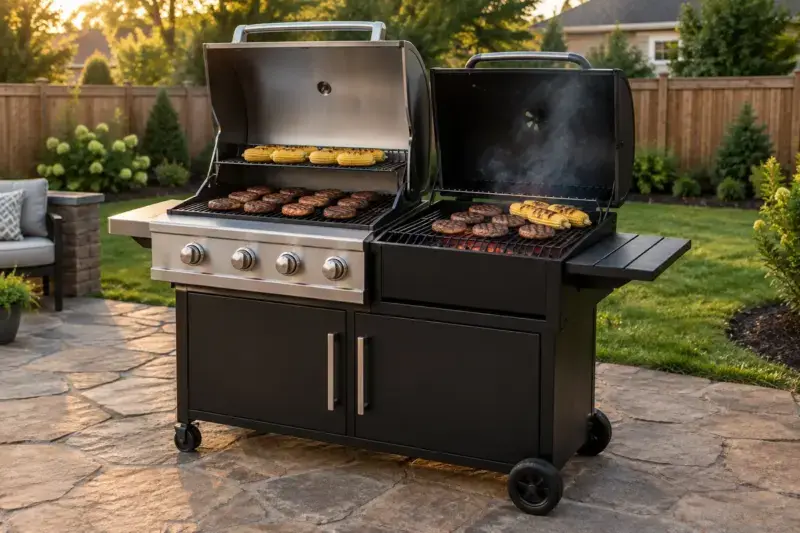
Side-by-side combo on a shared cart
This is the classic layout: a gas cookbox on one side, a charcoal cookbox on the other, each with its own lid and grates. Some models add a side burner or a small offset firebox. You can run both sides at the same time, and the ash stays away from the gas burners. The cost is width and weight. Measure your patio before you order, and check whether the cart has locking casters.
Gas grill with a charcoal tray insert
Some gas grills accept a manufacturer-made tray that holds charcoal over the burners. On Char-Broil's Gas2Coal grills, you line the tray with briquettes and the gas burners light them. Char-Broil says its 4-burner model can cook on gas and charcoal at the same time; on smaller models you switch between fuels. Use only the tray the manufacturer sells for your model.
Gas-assisted charcoal grill
Some charcoal grills use a small gas burner only to ignite the coals. The owner's guide for Weber's Summit Charcoal Grilling Center says its burner is for igniting the charcoal only and should never be used for cooking. You get no gas cooking zone.
Combo, two grills, or one grill? A decision table
| Option | Best for | Main trade-off |
|---|---|---|
| Side-by-side combo | Cooks who use both fuels most weeks and have one spot for a grill | Wide and heavy; all replacement parts come from one manufacturer |
| Gas grill + separate kettle | People who want to replace each grill on its own schedule | Two footprints and two covers |
| Gas grill with charcoal tray | Small patios where local rules allow both fuels | The tray sets the size of the charcoal area; some models run one fuel at a time |
| Gas-assisted charcoal grill | Charcoal cooks who hate waiting for a chimney | No gas cooking; you still clean ash after every cook |
If you already own a decent gas grill, a charcoal kettle next to it costs less than a new combo and gives you a bigger charcoal area.
What to inspect before you buy
Separate lids and a real divider
You want each side under its own lid, with a solid wall between the cookboxes. Without it, opening the charcoal lid dumps heat and smoke across the gas side.
Adjustable charcoal bed
A charcoal tray you can raise and lower with a crank turns the charcoal side into two grills: coals high for searing, coals low for slower cooking. With a fixed tray, you control heat only with the vents and the size of the fire.
Ash removal you will use
A pull-out ash pan saves you from scooping ash through the grates. Check that it slides out with the grill fully assembled; some carts put a shelf or tank holder in the way.
Vents on the charcoal side
Look for an intake vent low on the cookbox and an exhaust vent on the lid. A single lid vent gives you less control over low-and-slow cooks.
Gas side: burner count over headline BTUs
Weber explains that a BTU rating tells you how much fuel a grill uses in a given period, not how well it cooks. Burner count matters more: with two or more burners you can run one high and one low.
Parts and warranty
Combos have more parts that wear out: burners, igniters, charcoal grates and ash pans. Check that the manufacturer sells replacements for that model, and read what the warranty covers on each side.
When you have narrowed the field, you can compare current dual fuel combo grills on Amazon and filter by width and charcoal area.
How to run both sides on the same cook
A typical sequence for thick steaks, chops or chicken pieces:
- Light the charcoal first. Use a chimney starter so you do not need lighter fluid. Weber says the coals are usually ready in about 10 to 15 minutes, depending on the weather, once the top ones turn gray with ash.
- Start the gas side low or medium. It will be your finishing zone.
- Bank the coals across part of the charcoal grate for a direct searing zone.
- Sear over charcoal, finish over gas. Move the food to the gas side with the lid closed until it reaches your target temperature. Check with an instant-read thermometer, not the lid gauge.
- Close down the charcoal. Shut both vents to starve the fire and save the unburned coals.
For big roasts, reverse it: cook low on the gas side, then sear over charcoal. A charcoal chimney starter makes the first step faster and cleaner.
Propane safety on a combo grill
The gas side follows the same rules as any propane grill, but on a combo you also handle hot coals next to the tank.
- Leak-check the connection. The Propane Education & Research Council (PERC) says to test before the first use each season and each time you connect a cylinder: apply soapy water to the valve and connection, open the valve slowly and watch for bubbles. If bubbles appear, close the valve and tighten the connection; if they persist, call your propane retailer. NFPA adds the hose and regulator to the check.
- Use a cylinder with an overfill prevention device. PERC says an OPD is required by law and that most OPD cylinders have a triangular handwheel marked "OPD." If you are not sure yours has one, exchange it.
- Store spare cylinders outdoors, away from the grill. PERC says never to store a cylinder in a basement, garage, shed or other enclosed area, or to put a spare under or near a grill. That rules out parking the spare in the cart under the charcoal side. NFPA 58, the Liquefied Petroleum Gas Code, and your local fire code govern propane storage.
- Keep ash away from the tank. NFPA says to let coals cool completely, then empty them into a metal container with a tight-fitting lid, kept outside and away from anything that can burn.
- Respect clearances. NFPA says to keep the grill well away from the home and deck railings and out from under eaves and branches. The CPSC gas grill fact sheet says to use it at least 10 feet from your house or any building. Check your HOA or city rules for decks and balconies.
Converting the gas side to natural gas depends on the brand. Weber does not allow conversions of its North American gas grills and says converting voids the warranty and might create an unsafe situation. Never swap in generic orifices or regulators.
Cleaning and seasonal care
On the charcoal side, empty the ash once it is cold. Weber warns that ashes left in the ash catcher can promote corrosion.
On the gas side, empty the grease tray before it fills. The CPSC fact sheet says to check the venturi tubes at least once a year for blockage by insects, spiders or food drippings and to clear them with a pipe cleaner or wire. Weber's owner's guide lists the warning signs: a gas smell with very yellow, lazy flames, or a burner that pops.
Cover the grill when it cools. A fitted cover sized for combo grills keeps rain out of the ash pan; lift it after a storm to let the grill dry.
Frequently asked questions
Can I use both sides of a dual fuel grill at the same time?
On side-by-side combos, yes; that is the main reason to buy one. On tray designs it depends on the model: Char-Broil says its 4-burner Gas2Coal runs gas and charcoal together, while smaller tray models switch between fuels.
Can I put charcoal in a regular gas grill?
Only with a tray the manufacturer designed for that grill. If the manual does not mention charcoal, don't use it.
Is a combo grill harder to maintain than two grills?
The tasks match: ash on one side, grease and burners on the other. Empty the ash once it is cold after each cook.
Sources
- Safety Guide for Portable Propane Cylinders, Propane Education & Research Council (2025)
- Grilling safety, National Fire Protection Association
- NFPA 58, Liquefied Petroleum Gas Code, National Fire Protection Association
- Gas Grill Fact Sheet (Publication 467), U.S. Consumer Product Safety Commission
- Gas2Coal hybrid grills, Char-Broil
- Summit Charcoal Grilling Center owner's guide, Weber
- How do I use my chimney starter?, Weber
- How Important are BTU's?, Weber
- Can I Convert My Gas Grill?, Weber
- Easy Ways to Spruce Up Your Grill for the Season, Weber
If you want to know other articles similar to Dual Fuel Gas and Charcoal Grill Combo: How to Choose and Use One (2026) you can visit the category Gas Grill Reviews.