
Best Wireless Meat Thermometer for Rotisserie Grilling: Buyer's Guide (2026)
As an Amazon Associate we earn from qualifying purchases. Product links on this page may be affiliate links.
Last reviewed: October 2026. Sources last checked October 21, 2026. We have not run our own hands-on comparison of the models on the market; this guide explains what to look for and how to use a probe on a spit. Device figures below are manufacturer-stated.
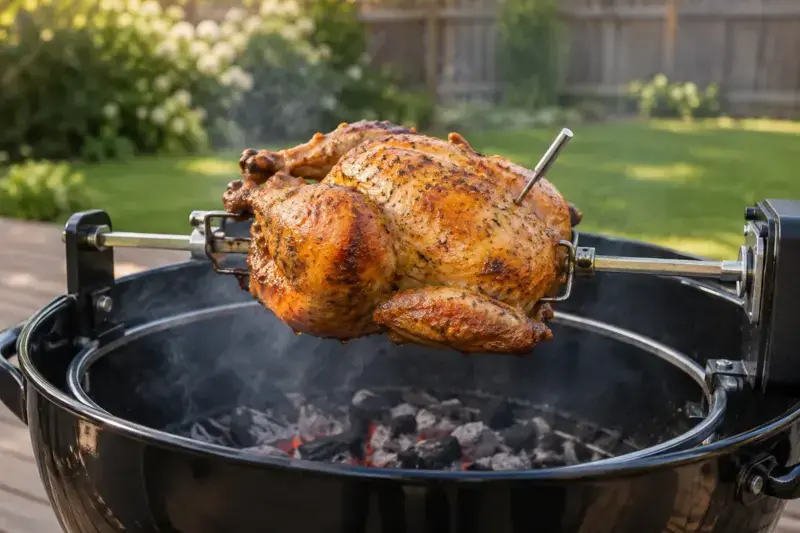
A rotisserie turns the meat, so any thermometer with a cable wraps around the spit within a few turns. For rotisserie grilling you need a probe with no wire at all: the battery and radio sit inside the probe, and it spins with the food. The best wireless meat thermometer for rotisserie work is the one whose exposed end tolerates your grill's heat, whose signal reaches you through a closed lid, and that you can place in the thickest part of the meat without touching the spit rod.
- Why rotisserie cooking is hard on thermometers
- Types of thermometers and how they fit a rotisserie
- What to compare before you buy
- How to place a wireless probe on a spit
- Target temperatures and carryover
- Check your thermometer's accuracy
- Mistakes that cost you a good roast
- Frequently asked questions
- Sources
Why rotisserie cooking is hard on thermometers
On a spit, the probe passes the heat source on every turn. When the meat rotates toward a rear infrared burner or a bed of coals, the exposed end of the probe gets far hotter than it would on a roast sitting over indirect heat. Then it swings away and cools. The signal also has to get out of a closed grill while the probe rotates behind the meat and the metal spit forks.
Three problems follow from that:
- Heat on the exposed end. Each fully wireless probe has a maximum ambient temperature. MEATER, for example, rates its Original, Plus, SE and Block probes to 527°F ambient and its Pro line to 1,000°F, and says that going above the limits may damage the probe.
- Signal dropouts. A closed metal grill is a poor place for a small radio, and rotation adds periodic gaps.
- Misleading readings. The steel spit rod runs through the center of the meat and heats up with the grill. USDA FSIS says to keep a thermometer away from bone; keep the probe tip off the rod for the same reason.
Types of thermometers and how they fit a rotisserie
| Type | Works on a turning spit? | Where it fits |
|---|---|---|
| Fully wireless probe (battery inside the probe) | Yes | Continuous monitoring through the whole cook |
| Wired probe with Bluetooth or Wi-Fi base | No; the cable wraps around the spit | Smokers, roasts on a grate, the grill's air temperature |
| Instant-read thermometer | Yes, with the motor stopped | Spot checks before you pull the meat |
| Built-in lid gauge | Not for food | A rough idea of air temperature near the lid |
For most people the right setup is one fully wireless probe plus a fast instant-read thermometer. The wireless probe tells you when to start checking; the instant-read confirms the temperature in several spots.
What to compare before you buy
Ambient temperature rating
Find the maximum ambient temperature in the manufacturer's specifications, not in the ad copy, and compare it with how you cook. A spit over indirect heat at moderate temperatures is gentle; one spinning a few inches from an infrared burner or a pile of hot coals is not. If you sear at the end, pull the wireless probe first. MEATER recommends the same compromise: use the probe for the cook, not the sear.
Signal path: direct, repeater or Wi-Fi bridge
Some probes talk straight to your phone over Bluetooth. Others send the signal to a charging dock that acts as a repeater. The MEATER Plus guide lists a probe-to-dock range of up to 33 feet in open air and recommends keeping the dock as close to the probe as possible and within line of sight. It also warns against leaving the dock on the side of a grill you are using, and rates the dock to 140°F. Some docks, such as the MEATER Block, forward readings over your home Wi-Fi. Read your manual for where the maker wants the base.
Probe length and the insertion mark
Many wireless probes have a notch or line that marks the minimum insertion depth. MEATER says its probes do not suit small cuts: the end can stick out of the meat, which causes inaccurate readings and exposes the probe to heat that can damage it. Check the probe length against what you cook most.
Number of probes
A whole chicken or turkey on the spit cooks unevenly between breast and thigh. Two probes let you watch both. For a single pork loin or prime rib, one probe is enough.
Battery life and charging
A long rotisserie cook can run for hours. Check the rated battery life per charge (MEATER lists 24 hours of cook time for the Plus probe) and how long a full charge takes, and charge the probe the night before.
Cleaning
Check whether the probe is dishwasher safe or hand-wash only. MEATER, for instance, says its Alpha Collection probes (Original, Plus, SE and Block) are not designed to be dishwasher-safe.
When you know your temperature and probe-count requirements, you can browse wireless meat thermometers on Amazon and filter by those specs.
How to place a wireless probe on a spit
- Truss and balance the meat first. Load the spit, tighten the forks, and run the motor for a few turns with the heat off. An unbalanced roast flops at the top of each turn and can knock the probe loose.
- Find the thickest part away from the rod. On a chicken, that is the thickest part of the breast or the innermost part of the thigh. On a roast, FSIS says to aim midway into the thickest part.
- Insert at an angle that avoids the rod and bone. Push the probe in past the insertion mark so the tip sits in muscle only.
- Point the exposed end away from the heat. On a grill with a rear burner, set the probe so it spends as little time as possible facing it. Check that it clears the hood and the drip pan through a full rotation.
- Check the connection before you close the lid. Confirm the app shows a reading, close the lid, and watch it for a couple of turns. If it drops out, move the dock closer.
Target temperatures and carryover
The USDA FSIS safe minimum internal temperature chart lists the numbers that matter most for rotisserie cooking:
- All poultry (whole birds, breasts, legs, thighs, wings): 165°F.
- Beef, pork, veal and lamb steaks, chops and roasts: 145°F, then rest for at least 3 minutes.
- Ground meats: 160°F (relevant if you spit-roast gyro-style ground meat).
FSIS says to measure these minimums with a food thermometer before you remove the food from the heat, so make sure the meat reaches them on the spit. Large roasts keep climbing after you pull them; if you cook beef above 145°F for doneness, you can pull a few degrees before your target and let carryover finish it. For whole poultry, FSIS says to check three places: the innermost part of the thigh, the innermost part of the wing and the thickest part of the breast. An instant-read thermometer makes those checks fast.
Check your thermometer's accuracy
FSIS describes an ice water check. Fill a large glass with ice, add water and stir. Put the thermometer stem at least 2 inches into the mixture without touching the sides or bottom, wait at least 30 seconds, and read it. It should show 32°F; if it doesn't, follow the manufacturer's calibration instructions or contact support. Boiling water works too, but FSIS notes that water boils lower at high altitude, by at least 2°F and as much as 5°F.
Mistakes that cost you a good roast
- Trusting the lid thermometer for doneness. It reads air near the lid, far from the meat.
- Placing the probe tip against the spit rod.
- Leaving the wireless probe in for a high-heat sear at the end.
- Pulling poultry on one reading instead of checking thigh, wing and breast.
- Letting the probe battery run low during a long cook.
Frequently asked questions
Can I use a wired probe thermometer with a rotisserie?
Not while the spit turns. The cable wraps around the rod within a few rotations. You can clip a wired probe at grate level, away from the spit, to monitor air temperature and check the meat with an instant-read.
Why does my wireless probe keep disconnecting on the rotisserie?
The probe sends a small signal out of a closed metal grill, and the meat and spit block it on part of each turn. Move the dock closer and within line of sight, as MEATER advises, but keep it off hot surfaces.
How many probes do I need for a rotisserie chicken?
One works if you place it in the thickest part of the breast and confirm the thigh and wing with an instant-read. Two probes, one in the breast and one in the thigh, let you skip opening the lid.
Is it safe to leave a wireless probe in the meat while it rests?
Yes. It lets you watch the carryover rise, and some apps, MEATER's included, estimate rest time. Keep the dock out of direct sun, as MEATER advises.
Sources
- Safe Minimum Internal Temperature Chart, USDA Food Safety and Inspection Service
- Food Thermometers, USDA Food Safety and Inspection Service
- Maximum Temperatures, MEATER Support
- MEATER Plus Support Guide, MEATER Support
- MEATER Block Support Guide, MEATER Support
- Can I Cook Small Cuts of Meat with MEATER?, MEATER Support
If you want to know other articles similar to Best Wireless Meat Thermometer for Rotisserie Grilling: Buyer's Guide (2026) you can visit the category BBQ Tips.