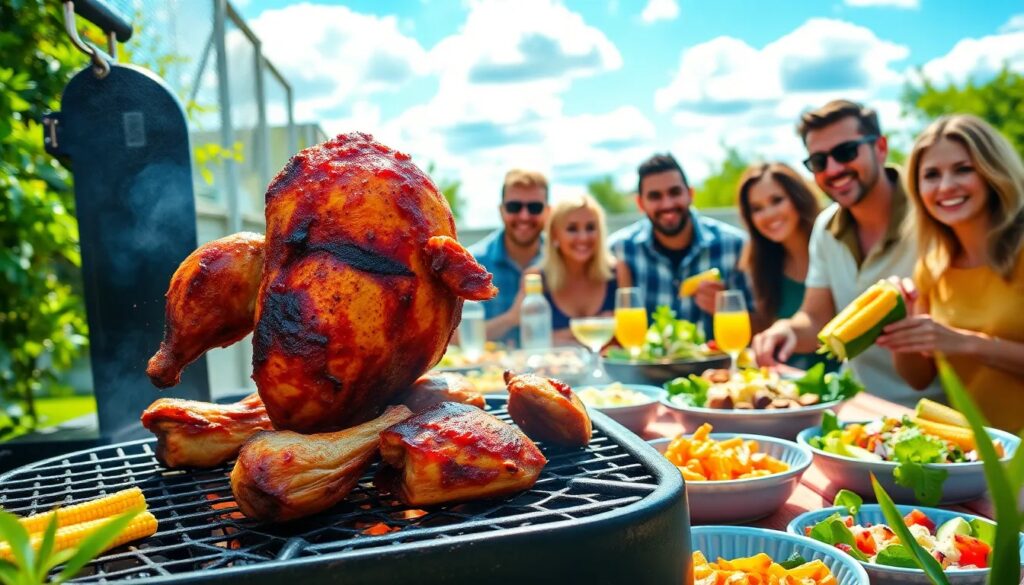
Mastering outdoor culinary craft requires an uncompromising understanding of organic chemistry, muscle histology, and thermodynamic heat transfer. Within our dedicated culinary testing kitchen, Chicken Marinades focuses on the exact biological and chemical transformations that occur when proteins, marinades, dry rubs, and combustion gases interact under controlled heat. Too many home cooks rely on vague intuition, subjective timers, or aggressive direct flame, resulting in tough collagen structures, evaporated moisture, or acrid bitter creosote deposits. This category hub serves as your empirical culinary reference, organizing tested recipes, exact internal temperature milestones, equilibrium brining ratios, and wood smoke pairing data. Every technique documented here has been refined through multi-probe thermal data logging, repeated recipe trials, and objective meat tenderness analysis.
Meat Science, Thermal Breakdown & Flavor Chemistry in Chicken Marinades
The foundation of exceptional Chicken Marinades rests on controlling protein denaturation, fat rendering, and surface moisture evaporation. During low-temperature smoking between 225 and 250 degrees Fahrenheit, tough connective tissues rich in collagen begin their hydrolytic conversion into rich, gelatinous gelatin between 160 and 180 degrees Fahrenheit. This transition is accompanied by the evaporative cooling phase commonly known as the stall, where surface moisture evaporation matches heat input and temporarily halts internal temperature rise for several hours. Understanding this physics prevents premature panic and ensures juicy results without boiling meat fibers in their own juices.
Critical culinary standards governing our recipes and guides include:
Internal Temperature Targets: Verification with calibrated thermocouple probes (+/- 0.5 degrees Fahrenheit) targeting precise doneness rather than arbitrary cooking times or clock estimates.
Equilibrium Brining: Salt calculations based on 1.0% to 1.5% total meat weight dissolved uniformly to alter muscle protein structure and retain intercellular water throughout long cooks.
Combustion Gas Interaction: Fostering a clean thin blue smoke profile through efficient fuel combustion, avoiding black smoldering particulates that deposit harsh acrid phenols onto food surfaces.
Resting Thermodynamics: Allowing internal pressure gradients to equalize post-cook inside an insulated environment, preventing rapid moisture loss when muscle bundles are sliced.
Surface Moisture Management: Achieving clean pellicle formation and surface drying prior to smoking, optimizing smoke particle adhesion while facilitating deep mahogany bark development.
Whether balancing rub salinity, crafting balanced emulsions for basting, or monitoring crust development, precision execution yields consistent championship results across every meal.
Frequently Asked Questions About Chicken Marinades
What is the most accurate indicator of doneness in Chicken Marinades?
Calibrated digital probe thermometry combined with mechanical tenderness testing is the only reliable method. Meat color, crust appearance, and elapsed cooking time vary drastically based on ambient humidity, airflow velocity, cut thickness, and muscle fiber density across individual livestock specimens.
How does smoke wood selection affect flavor in Chicken Marinades?
Different wood species release distinct ratios of lignin, cellulose, and hemicellulose combustion byproducts. Dense hardwoods like hickory and oak provide robust phenolic profiles suitable for beef, while fruitwoods like apple and cherry release sweeter lactones and syringol compounds ideal for pork and poultry cuts.
Why is temperature stability more critical than total cooking duration?
Stable convection currents ensure even rendering of intramuscular marbling without drying outer surfaces. Temperature spikes scorch sugars in rubs and contract outer muscle fibers before internal core collagen breaks down, creating dry, unevenly cooked meat.
Explore our Chicken Marinades — guides, reviews and practical BBQ tips from Barbecue360. Browse the latest guides and reviews below.
Go up
Manage consent
To provide the best possible experience, we use technologies such as cookies to store and/or access information on your device. Consent to these technologies will allow us to process data such as browsing behavior or unique identifiers on this site. If you do not consent or withdraw your consent, certain features and functions may be affected.
Functional Always active
Technical storage or access is strictly necessary for the legitimate purpose of enabling the use of a specific service explicitly requested by the subscriber or user, or for the sole purpose of carrying out the transmission of a communication over an electronic communications network.
Preferences
Technical storage or access is necessary for the legitimate purpose of storing preferences that have not been requested by the subscriber or user.
Statistics
Technical storage or access used exclusively for statistical purposes.El almacenamiento o acceso técnico que se utiliza exclusivamente con fines estadísticos anónimos. Sin un requerimiento, el cumplimiento voluntario por parte de tu proveedor de servicios de Internet, o los registros adicionales de un tercero, la información almacenada o recuperada sólo para este propósito no se puede utilizar para identificarte.
Marketing
Technical storage or access is necessary to create user profiles for the purpose of serving advertisements, or to track users across one or more websites for similar marketing purposes.